
Analog Devices AD600JR-REEL7
$ 20.56
Preço e estoque
Distribuidores autorizados
Distribuidores de estoque não autorizados
Revendedores não autorizados

Histórico de estoque
Tendência de 3 meses: +0.00%

Modelos CAD
Baixe o símbolo, a pegada e o 3D STEP

Peças alternativas
1 peça disponível

Modelos CAD
Baixe o símbolo, a pegada e os modelos 3D STEP de Analog Devices AD600JR-REEL7 direto dos nossos confiáveis parceiros.
| FONTE | eCAD | mCAD | ARQUIVOS |
|---|---|---|---|
 Ultra Librarian Ultra Librarian | SímboloPegada | Baixar |
O site do parceiro será aberto em uma nova aba ao baixar os seus modelos CAD
Ao baixar os modelos CAD do Octopart, você concorda com nossos Termos e Condições e Política de Privacidade.
Peças alternativas
Esta peça
Peças alternativas


Price @ 1000
$ 20.56
$ 67.458
$ 67.458
Stock
108,602
250,510
250,510
Authorized Distributors
1
6
6
Case/Package
SOIC
SOIC
SOIC
Number of Pins
16
16
16
Number of Circuits
2
2
2
Slew Rate
275 V/µs
275 V/µs
275 V/µs
Gain Bandwidth Product
35 MHz
35 MHz
35 MHz
Input Offset Voltage (Vos)
-
-
-
Power Supply Rejection Ratio (PSRR)
-
-
-
Common Mode Rejection Ratio
30 dB
30 dB
30 dB
Min Supply Voltage
-4.75 V
-4.75 V
-4.75 V
Max Supply Voltage
5.25 V
5.25 V
5.25 V
Operating Supply Current
14 mA
14 mA
14 mA


Descrições
Descrições de Analog Devices AD600JR-REEL7 fornecidas pelos seus distribuidores.
SP Amp Variable Gain Amp Dual ±5.25V 16-Pin SOIC W T/R
Non-RoHS Compliant R-PDSO-G16 TIN LEAD Tape & Reel (TR) op amp amplifier circuit 10.3mm 350nA 4.75V 35MHz
IC VARIABLE GAIN 2 CIRC 16SOIC
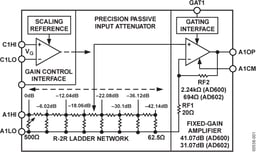
The AD600/AD602 dual channel, low noise, variable gain amplifiers are optimized for use in ultrasound imaging systems, but are applicable to any application requiring precise gain, low noise and distortion, and wide bandwidth. Each independent channel provides a gain of 0 dB to +40 dB in the AD600 and -10 dB to +30 dB in the AD602. The lower gain of the AD602 results in an improved signal-to-noise ratio (SNR) at the output. However, both products have the same 1.4 nV/√Hz input noise spectral density. The decibel gain is directly proportional to the control voltage, accurately calibrated, and supply and temperature-stable. To achieve the difficult performance objectives, a proprietary circuit form, the X-AMP®, was developed. Each channel of the X-AMP comprises a variable attenuator of 0 dB to -42.14 dB followed by a high speed fixed gain amplifier. In this way, the amplifier never has to cope with large inputs, and can benefit from the use of negative feedback to precisely define the gain and dynamics. The attenuator is realized as a 7-stage R-2R ladder network having an input resistance of 100 W, laser trimmed to ±2%. The attenuation between tap points is 6.02 dB; the gain-control circuit provides continuous interpolation between these taps. The resulting control function is linear in dB. The gain-control interfaces are fully differential, providing an input resistance of ~15 M W and a scale factor of 32 dB/V (that is, 31.25 mV/dB) defined by an internal voltage reference. The response time of this interface is less than 1 µs. Each channel also has an independent gating facility that optionally blocks signal transmission and sets the dc output level to within a few millivolts of the output ground. The gating control input is TTL- and CMOS-compatible. The maximum gain of the AD600 is 41.07 dB, and the maximum gain of the AD602 is 31.07 dB; the -3 dB bandwidth of both models is nominally 35 MHz, essentially independent of the gain. The SNR for a 1 V rms output and a 1 MHz noise bandwidth is typically 76 dB for the AD600 and 86 dB for the AD602. The amplitude response is flat within ±0.5 dB from 100 kHz to 10 MHz; over this frequency range, the group delay varies by less than ±2 ns at all gain settings. Each amplifier channel can drive 100 W load impedances with low distortion. For example, the peak specified output is ±2.5 V minimum into a 500 W load, or ±1 V into a 100 W load. For a 200 W load in shunt with 5 pF, the total harmonic distortion for a ±1 V sinusoidal output at 10 MHz is typically -60 dBc. The AD600J/AD602J are specified for operation from 0°C to 70°C and are available in 16-lead PDIP (N) and 16-lead SOIC packages. The AD600A/AD602A are specified for operation from -40°C to +85°C and are available in 16-lead CERDIP (Q) and 16-lead SOIC packages. The AD600S/AD602S are specified for operation from -55°C to +125°C, are available in a 16-lead CERDIP (Q) package, and are MIL-STD-883 compliant. The AD600S/AD602S are also available under DESC SMD 5962-94572. AD600 - Gain Range: 0 dB to 40 dB AD602 - Gain Range: -10 dB to + 30 dB
Nomes alternativos do fabricante
Analog Devices possui diversas marcas em todo o mundo que os distribuidores podem usar como nomes alternativos. Analog Devices também pode ser conhecido(a) pelos seguintes nomes:
- Analog Devices Inc
- ANALOG
- ADI
- ANALOG DEVICE
- ANALOG DEV
- AD
- ANA
- PMI
- Analog Devices Inc/Maxim Integrated
- ADV
- ADA
- ANALOG DEVIC
- PMI/AD
- ANALOG DEVI
- AD/PMI
- STOCK
- Analog Devices / Linear Technology
- ANALOG INTERGRATIONS CORP
- AD - Analog Devices
- PRECISION MONOLITIC INC
- ADI (Analog Devices Inc)
- ANADEV
- Analog Devices / Hittite
- ANALOG DEVICES (ADI)
- ANLOGDEVIC
- Analog Devices Inc.
- Maxim Analog Devices
- Analog Devices / Maxim Integrated
Histórico de estoque
Tendência de 3 meses: +0.00%
Modelos CAD
Baixe o símbolo, a pegada e o 3D STEP
Peças alternativas
1 peça disponível
Especificações técnicas
Physical
Case/PackageSOIC
Contact PlatingLead, Tin
MountSurface Mount
Number of Pins16
Technical
-3db Bandwidth35 MHz
Bandwidth35 MHz
Common Mode Rejection Ratio30 dB
Dual Supply Voltage5 V
Gain Bandwidth Product35 MHz
Input Bias Current1 µA
Max Dual Supply Voltage5.25 V
Max Operating Temperature70 °C
Max Power Dissipation600 mW
Max Supply Voltage5.25 V
Min Dual Supply Voltage4.75 V
Min Operating Temperature0 °C
Min Supply Voltage-4.75 V
Nominal Supply Current14 mA
Number of Channels2
Number of Circuits2
Number of Elements2
Operating Supply Current14 mA
Operating Supply Voltage5 V
Output Current per Channel50 mA
Power Dissipation600 mW
Resistance102 Ω
Slew Rate275 V/µs
Voltage Gain41.07 dB